
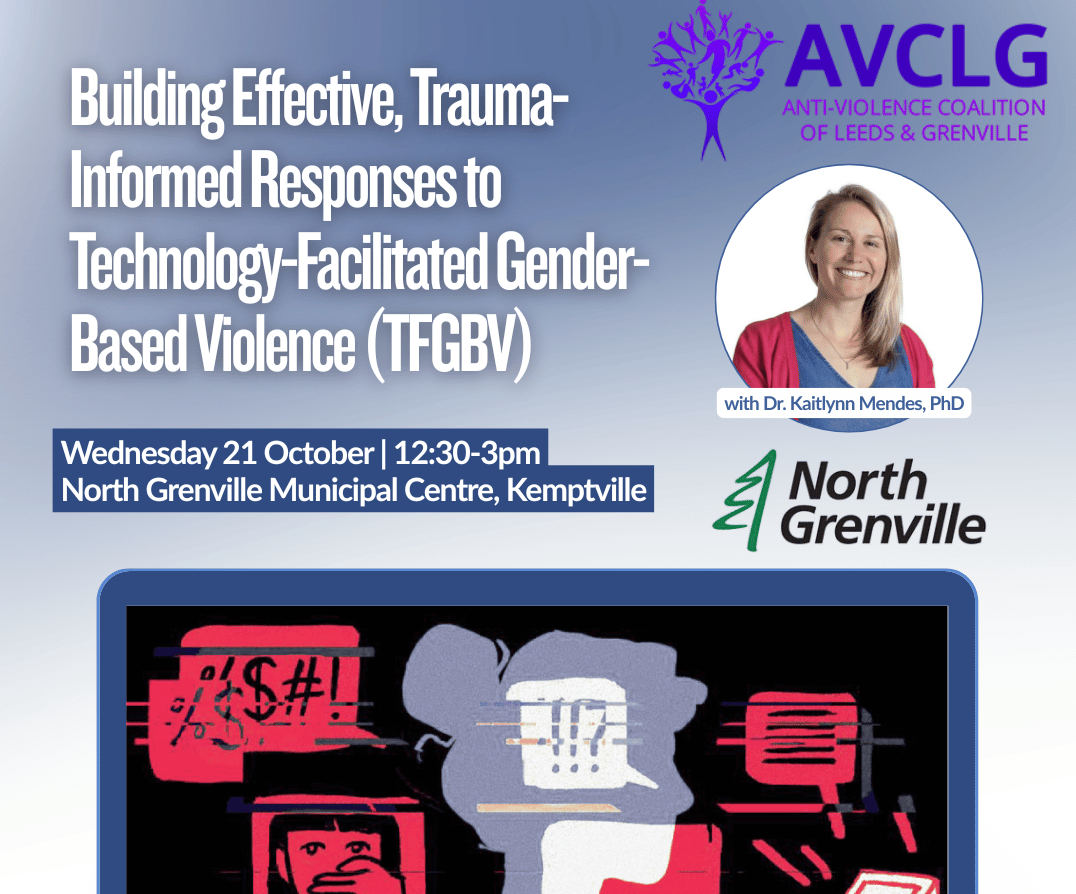
Building Effective, Trauma-Informed Responses to Technology-Facilitated Gender-Based Violence


Join Dr. Mendes for a practical, evidence-informed training designed for the people supporting young people as they navigate an increasingly digital world. This session will explore image-based sexual abuse, cyberharassment, cyberstalking, deepfakes, non-consensual image sharing, online coercion, and other forms of TFGBV, with a focus on the crucial question: What do we actually do when a young person tells us this is happening?
Designed for police, educators, school administrators and counsellors, social service providers, youth-serving professionals, advocates, community leaders, and others supporting young people, the session will move beyond awareness and abstinence-style messaging to provide practical strategies for trauma-informed responses, disclosure, documentation, reporting, referrals, and stronger organizational practices.
Participants will leave with concrete tools, resources, and next steps they can bring back to their schools, organizations, and communities.
This is about more than telling young people how to stay safe online. It’s about making sure the adults around them know what to do when safety is compromised.
 Wednesday 21 October 2026
 12:30-3:00pm
 Kemptville, ON

Dr. Kaitlynn Mendes is a Professor of Sociology, holds the Canada Research Chair in Inequality and Gender, and is the Interim Academic Director of the Centre for Research and Education on Violence against Women and Children at Western University. She has spent the past 15 years studying how digital technologies shape young people’s lives. Rather than advocating for removing tech from young people, her work focuses on helping youth build healthy, positive relationships with technology and ensuring that when harm happens online, young people have access to meaningful support. She currently leads the DIY: Digital Safety Project which has gone around Canada and collected data from over 2,000 teens to better understand their online experiences. She takes this knowledge to work with communities, educators, and policymakers to push for better tech regulation, education, and services that truly meet young people’s needs.